Read the older posts first to better understand how the story unfolds.

Showing posts with label shantytown. Show all posts

Thursday, September 4, 2014

New Orleans City Council to discuss the homeless


September 4, 2014 New Orleans, LA USA  A few months ago I kept seeing a young girl who was 9 months pregnant and panhandling. I was always in a hurry.  I never parked my car to go back and talk to her. Her sign did not mention her obvious state of being. Having been pregnant myself there was not doubt about this child’s condition. I have no idea what her story was. I saw her for several weeks sitting in the New Orleans summer heat with her sign.  She disappeared about the time that baby was due.  I wonder if she was able to keep her infant?
Then on Labor Day on almost the same corner I saw a mom with her two kids also panhandling. This time I stopped to say hello.
The mom explained she is unemployed and can’t seem to find a way out of her circumstances. While job hunting she needs to take her children along. The employment agency she went to does not allow children and it is hard to take kids job hunting in general. She can’t get a job without childcare and can’t get childcare without a job. 
There must be an agency that could assist her through this journey but she rattled off most of them off while describing her experiences. I never know what anyone’s personal truths are but I certainly do not doubt her frustration.
If a single parent gets to the point that they are homeless they want to hide that fact. Why? Not only out of shame but because parents on the edge of poverty fear having their children taken away. 


Catty corner to where these women had panhandled is a new homeless camp. The camp sprung up after being displaced by a sweep a few weeks ago. The sweep was done to create more parking for tailgating prior to Saints football games.
The new camp is a mix of people. While the homeless population always segregates along lines of common interest, this particular camp seems to house a lot of women. One end of the camp appears to be more easy going friendly folks. On the other side, residents seem to want to mind their own business.

In a previous post I mentioned being baffled that the neighborhood could comment on the TV news about the camp since it was really only visible from one home.That one historic townhouse with a view is surrounded by parking lots and is one of the only few homes that survived construction of the bridge. The camp IS however visible from the street and is surrounded by traffic on all sides.
While making portraits in the camp last week I looked up and saw a man with a camera. He obviously was not working on an art project like me.  He was not paying much attention to how he was shooting and he appeared nervous.   
The homeless ladies didn’t like the feeling of being stalked and the group leader went out to have a word with the stranger who was soon pointing and shouting “Don’t mess with me, I know my rights!” and the camp leader shouting back “You should ask before taking pictures!”  I could see both men were having their manhood tested. 
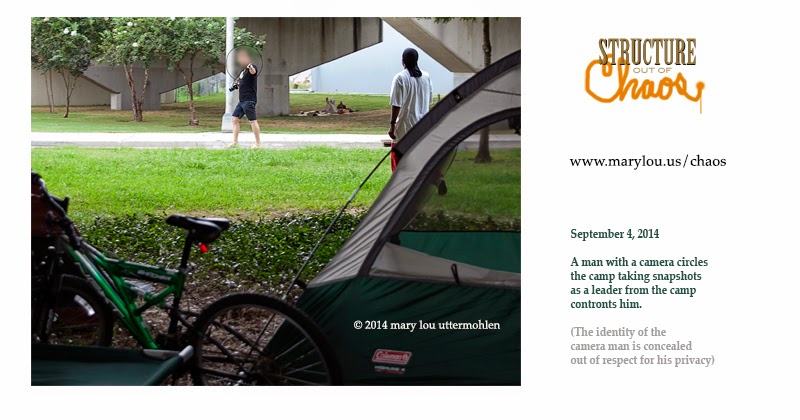
The camp watched as the man with the camera ran and took refuge in the townhouse. I felt bad for him as it was clear to me he was angry and felt threatened. Surely he was taking photos to document his problem.  He has a homeless camp catty corner to his home and my guess is that it makes him uncomfortable.
I can see both angles. It is also hard for the homeless people to deal with photographers. I should know since I’m one of those people making images of them. When people are down they don’t like being reminded of it or gawked at like they don’t matter. Or worse, have their image attached to someone else’s story about them. That is why my work is a documentary through “portraiture."   The viewer is well aware of what I am doing and why I am there. I avoid wide shots often to edit people out who do not want to be photographed.
I can tell there are folks who don’t care where the homeless go as long as they never “see” them again. Where do people live when they have nowhere to go?  Is it right to force people to keep moving to appear invisible?  Is invisibility really a solution? Keeping the weakest members of society at a disadvantage does not seem to “help” them get their world organized. Should they really be forced to own nothing but that which they can carry? Or should people be allowed a spot somewhere that they can organize their lives and work their way back up?  A place where they get to take part in leadership and make rules like adults. A place to call home.

I also want to address the issue of cleanliness. I have seen homeless people sweep their camps,wash their laundry, change their sheets, bag trash, use toilet buckets with liners, and collect pee in bottles for proper disposal. Ok I had to believe them about the pee as it felt like TMI.

Some campers (not all) seem to be working hard to prove their worth to a parent that doesn’t seem to notice. Or maybe they are just doing these things for themselves and their own dignity. I do not know. 
So what is going to happen to this camp?  Today the issue is supposed to be debated by the New Orleans City Council at approximately 2PM. Here is an ordinance that will be discussed:
Ordinances to amend the City Code relative to obstruction of public rights-of-way and public places relative to sidewalk obstruction regulations and enforcement. (Expected to be addressed at 2 p.m.)

35. CAL. NO. 30,273 - BY:  COUNCILMEMBER CANTRELL (BY REQUEST)


The camps in question are not on side walks and do not obstruct passage although they are located on public land. Will the city use this ordinance as a way to force homeless people to move again?
Will the City of New Orleans work towards criminalizing homelessness by enforcing laws? That approach did not go well for Miami or Los Angeles who were sued by the ACLU for violating the civil rights of homeless people. 
Or will the City of New Orleans recognize that the homeless issue needs to be faced? They could consider a 1% tax on alcohol like Miami has to fund homeless programs. They could also consider allowing tent cities like in Portland where the residents help to run the camps hidden from public view.  If they have several camps and keep them small they may be an asset for the homeless and not a liability to tourism.  Or they could enforce camping time periods like they do on skid row in Los Angeles.
We can resist our social issues or deal with it and move beyond them. I’m praying the city council will use good judgment and to think of ALL the citizens that call New Orleans home. Certainly, that is not an easy job they have.


Sunday, October 14, 2012

Pets of the homeless


Homeless people have pets.  Or is it that the animals in crisis gravitate to the homeless people as there is a connection of souls that need each other. When I started this project in the 1990’s the encampments that I visited were rather large. Just about every day dogs and cats were dropped off because someone didn’t want them and it became the responsibility of the homeless people to see that the animals ate.  Sadly the pets were not spayed or neutered and there were endless litters of puppies and kittens.  Also in the camps were ducks and chickens that the dogs and cats seem to ignore. Chickens are popular in Miami for fresh eggs and they are a common sight around the city.  

Homeless people with pets know that they can't take them everywhere.  The owner may need to go off to eat at a shelter or meet with social workers. When ever they leave a pet even for a short period they need to trust that someone will look after it in their absence or they risk losing that companion.

The saddest most confusing experience I witnessed during this project was when  the encampments were being closed down and strangers appeared to decide the fate of the pets. Animal control came and gathered up pets to take off to the pound. Concerned citizens came to lay claim on a few puppies and kittens. None of them took into account that the animal they were taking belonged to someone.  Not only were the residents of the camp losing their shanties, their pets were being taken away as if they were neglectful caretakers.

One man had a dog (See the photo above) that went almost everywhere with him. The dog was always on a leash. On eviction day he left the dog at his shanty and went on an errand. While he gone his dog was taken away to the pound. Even if he wanted his friend back he didn’t have the transportation or the money to retrieve his beloved dog. It broke my heart because I imagined how I would feel if it happened to me.

There is certainly a gray area of what is right and what is wrong.  Just because a human is homeless does that mean they do not have the right to have a dog or a cat? From the reactions of the stranger that day I almost felt they were more concerned for the animals than the people. I was trying my best to observe and stay neutral but I had a hard time watching the homeless man I knew grieving for his dog.

Encampment residents that refused to accept “treatment” must now become wanders without shelter and the talk I heard all around me on eviction day was what about the homeless pets? I like animals a lot but what about the people?  What is going to happen to them? The answer was that treatment was offered. They have the right to refuse treatment. Outreach workers are not responsible for people that refuse treatment. I heard sorrow for the pets because the pets did not choose this existence but the people did. Is homelessness a choice? Do pets have more rights than the people? I ask this knowing that the pets in the animal shelter if not adopted will more than likely be euthanized.

I agree the majority of homeless people I photographed appeared to have substance abuse issues. But it was not true for all of them. There was not a social program for every problem there was only a list a programs dealing mostly with drugs and alcohol adiction. Regardless of why the resident was homeless the ultimatum was simple: accept a program or not. Either way, this shack will be demolished on this date and if you do not hide your pet you will be permanently separated from it.

At the camp of sex offenders (Bookville) in 2010 there were a lot of cats but no dogs. The cats were good at keeping down the rodent population however they often sprayed their territory and you could smell their presence.  Residents learned to keep valuables like spare shoes away from the prowling felines who would certainly mark them.

The sex offenders were middle class citizens unable to move home with their families due to laws prohibiting it. They were homeless by force and not homeless by choice. They wore leg monitors to assure they check into the camp under the bridge each night.  Sleeping under a bridge was not a place they wanted to call home. The residents agreed not to bring dogs there because they liked dogs and didn’t want to see the animals suffer in anyway.  When strays wandered into the camp they would find it a good home.

Is it right for homeless people to have pets when by society’s standards they are not even capable of taking care of themselves?  Or is possible that pets in their lives are sources of unconditional love that the individual may need? Regardless of the reason that a person is in a chronically homeless situation it may be nice to believe that a pet could encourage a positive transformation. Receiving unconditional love may be healing feeling even if it comes from an animal.


Here is a link to a story in Los Angeles about a dog that touched the hearts of people living on skid row: http://www.latimes.com/news/opinion/commentary/la-oe-dietrich-dog-skid-row-20120820,0,6492641.story


Please check out my website for this project at http://www.marylou.us/chaos .  I also have a facebook presence at http://www.facebook.com/pages/Photographer-MaryLou-Uttermohlen/201723200603?ref=hl . This part of the project was made possible by an individual artist fellowhip of $5,000 from the State of Florida. 

Thursday, September 27, 2012

Defining the criteria


 My desire is to show homeless people that build shelters to live in.  I can’t assume that people would be willing to let me in their houses or that they would be willing to be photographed at all.   But if I ask enough people the same question eventually someone will say yes.   Once I earn one person’s trust it gets easier to convince others. Eventually I did get inside the homes but there was not always a photo there to be created. Getting access is not enough. I need to be able to create a great image from whatever I find. 


Picture yourself being in a plywood box. The room is so small that it is hard to show it all with a wide angle lens.  If the subject is too close to the camera then a portrait will look like a headshot in front of plywood. What does that tell the viewer about this story? Not much. 


As soon as I started looking through my lens to compose photos it would become clear that it is hard to tell I was in a shantytown.  How best do I visually explain that these people are in a personal crisis and not just weekend adventurers or somebody hanging around a shed? 


It is clear I had to create portraits and not reportage. That was a given since I needed to exclude the people who did not want to be photographed.  I can show some action shots but the body of work must primarily be people in their personal space with their things.  What do they own that they are proud of? What do they own that makes them feel better when they see it. Each home had some sort of prized possession. 


On  the very first day I started this project I toured a home in Bicentennial Park with my boyfriend. When we left the home my boyfriend turned to the homeowner and said “ I noticed a personal photo on you wall. Is that your daughter?”


 “No” the man replied “I found her photo on the ground and I liked it so I kept it. I like to look at her and think of my own family.” The man spoke with a Spanish accent. I don’t know where he came from but it might be a good guess that he was an illegal immigrant that left his family behind to come here and make a better life. 


No doubt, the images I create had to include the person’s environment to support their story. Once in a while a portrait could be a tight crop but if done too frequently the information that can be gathered by the location would be lost.


If I crop too much out the viewer doesn’t understand what is going on.  The images had to alert the viewer that the photo had something to do with homelessness or I was unable to communicate about the topic. Given that the people in the photographs are clean and well dressed I still have to find ways for the audience to make the association that the subject matter is about homeless. 


My criteria is
that the people could not just be homeless but had to have a shelter they created to enhance their safety and security. I had to be sure to watch what was unfolding for me and not look for a checklist to shoot. It is not my mission to project what I will discover but to wait for what opportunity and or person flows into my path.

Please check out my website for this project at http://www.marylou.us/chaos .  I also have a facebook presence at http://www.facebook.com/pages/Photographer-MaryLou-Uttermohlen/201723200603?ref=hl . This part of the project was made possible by an individual artist fellowhip of $5,000 from the State of Florida.


Friday, September 21, 2012

Portraiture rather than reportage


One day I disregarded the advice to avoid the crack block at the Miami River encampment and took a photograph without permission. I was watching people with the door of their home open. The river was in the background and the shanties in that area were well constructed with great carpentry. I thought that since the people in the shanty were unaware of me it made for a good shot. Or so I thought at the time.


Before long an angry man shouting in Spanglish was in my face and demanding the film. If I didn’t give it up he was going to hurt me. So I rewound the film to opened the back of my camera and gave him the leader off the roll. I was being sneaky and actually saved the shot that I latter determined wasn’t worth the effort.


I learned two things from that experience. First of all, stick with the people I am familiar with and trust. Secondly, if I’m going to be hanging out at homeless camps alone I can only photograph people who are aware of me and grant their permission. That is why my series is primarily portraiture. It tells the audience that I am present in the moment because I have permission to be there.


There was a wide range of people who would hang out with me but did not want to be photographed.  Since I am a guest in someone's home I needed to be respectful and not offend the people who’s trust I am trying to earn. So instead of creating news photographs I concentrated on my skill of working with light and trying to pull the personality of the individuals into the images.  I am co-creating a photograph with the subject as opposed to merely taking snapshots of whatever happens. The theme allows me to slow down and watch the light, the environment and the person.


Please check out my website for this project at http://www.marylou.us/chaos .  I also have a facebook presence at http://www.facebook.com/pages/Photographer-MaryLou-Uttermohlen/201723200603?ref=hl . This part of the project was made possible by an individual artist fellowhip of $5,000 from the State of Florida. .


Thursday, September 20, 2012

Self Segregation


To put it simply, "like attracts like."  People surround themselves with folks who like the same things. This is true in all segments of society.

When this project began in the early 1990's there were about 1,500 people living in shantytowns in downtown Miami, Florida (USA). One particular camp along the Miami River was in a parking lot that stretched for five blocks.

There was one potty john for hundreds of residents but it was never cleaned and too disgusting to get near. There was also one open fire hydrant for water so that people drink and bath. Dog, cats, ducks and chickens also called the parking lot home.


It was pointed out to me in this camp that every block had a different theme.  The block closest to the river was the crack block. I was encouraged to avoid that area because people on crack were paranoid and unpredictable. There were three other blocks of various drug habits but I avoided them completely.


Each camp around the city had a self appointed leader that they all happened to refer to as the mayor. Once I gained the respect of the mayors my ability to hang out with residents got easier.


The camp on the Miami River had one block where all the peace loving people lived. The mayor of the block was named Bobby and he named his block “cracker court.”  He explained to me that they don’t like any trouble around there. Troublemakers were urged to move on.


Cracker Court included illegal aliens, born again Christians with their own wooden church shack, harmless mentally ill folks and alcoholics. To be honest though it was primarily alcoholics. They worked during the days. They drank after dark when I wasn’t around. They didn’t like drugs or violence.  As long as I was around Bobby’s people I felt safe.  I was told which areas and people to avoid and trusted the advice.
 

There was another camp on Watson Island where Parrot Jungle is now. That camp was also peaceful and the demographics were similar to that of Miami River’s Cracker Court. Those two locations were my favorite to photograph.  Since I was alone and I was going into people’s shanties I had to establish a mutual trust factor.


It is really an interesting concept don’t you think? People at every level of our society segregate themselves to create their comfort zones. People who are drug addicts want to be around drug addicts and those that are not want to stay away them. People really do have a way of creating structure from the chaos around them.


Please check out my website for this project at http://www.marylou.us/chaos .  I also have a facebook presence at http://www.facebook.com/pages/Photographer-MaryLou-Uttermohlen/201723200603?ref=hl . This part of the project was made possible by an individual artist fellowhip of $5,000 from the State of Florida.

Friday, September 14, 2012

No Compensation


There always needs to be a balance between what you take and what you give but how can that be applied to this situation? Sure homeless people would love to be paid for participating in this project.  I would love to have been paid too. 

Many times I have been told  by people that they will act anyway I would like for the right price. Then they would show off a sad face thinking that drama would make a good photo about homelessness. That is not what I am going for at all. 

The goal of the project is to capture an honest depiction of a person’s life experience. When money enters the scene the purpose of their participation shifts.  They are no longer visiting with me because they trust me.  All the sudden my visit becomes a job with expectations. Since I never paid anyone, money was never an issue to manipulate people. Participation  in this project has always been voluntary.

This project has been self-financed with the exception of the $5000 individual artist fellowship from the state of Florida in 1998.  Photography is a expensive media.  I  never had the extra cash to pay people so paying participants has never been a  consideration.  I have always been upfront about that.

I explained to people what I am trying to do and asked for permission to hang out with them. If they agreed, I stayed. If they disagreed, I moved on. Eventually some people that didn’t trust me at first would latter welcome me and become a friend. Somehow I earn people's trust and respect and at that point they would become co-creators of this document.

Thursday, September 13, 2012

Defining who I AM


I started this project with a curiosity of wanting to see the inside of shanties and meet the residents of these villages. What are the lives of these people like? What leads them to this destination?  My purpose for creating this work was that I couldn’t drive by it everyday and not have my questions answered. I needed to know their story.

This first thing I learned from taking on this project was to detach emotionally from the people I was documenting. I figured this out by doing the opposite first. 
On my early camp visits I left  feeling sad. I wanted to help these people.  Perhaps I can find them jobs, bring food or collect clothing.   I was overwhelmed by a sense of “there by the grace of God go I.”  What if I were going through this experience? I was projected my feelings onto them.  

My gut reaction was to jump into action to do what ever I could to help. I was monitoring about five camps at the time and this included several hundred people.  The more food I handed out the more they wanted. The more I gave the more they needed. It doesn’t take a rocket scientist to know that I was out of my league. On my own I am not going to be able to save the world.  I do not have the skills or the resources to make a significant difference to these people.  Quickly I discovered that I was being pulled away from my original mission to observe.

Trying to solve problems for others is NOT the best use of my gifts.  To be able to move forward and be productive I had no choice but to define who I am and accept who I am not.   I am not a social worker, an activist, a lawyer, a nonprofit, or a fundraiser and the list of who I am NOT goes on. Who I am is a visual storyteller and it is my job to simply record and tell this story about a time and place. Perhaps my photographs could affect people to take action but I need to stick to what I do best and not try to become someone who I am not.


My first lesson from STRUCTURE OUT OF CHAOS was detachment.  If I get too emotionally involved I become the story instead of a witness. If that happens my photographs are no longer honest and will become propaganda manipulating the viewer on how they should feel. The photographs would become a projection of my emotions. No one can learn without an open mind and it does not serve any good to react emotionally without knowing the facts.  From a detached state of being I dropped my emotions and concentrated solely on my mission to experience and not react to the story.


Tuesday, July 31, 2012

Producing a final presentation


Where do I start to Blog about a topic that has been on my mind for almost 20 years?  When I moved to Miami in January 1993 the problems between homeless people and the City of Miami was already happening. I was in major culture shock arriving from the Midwest to a city where English is not the primary language. Then to have homeless people trying to wash my windshield at every stop light and seeing communities of people living in plywood boxes certainly made me question what was going on in this world.

I have this strong personal curiosity.  What are the daily lives of these people like? What do their shacks look like on the inside? How do they feel about living like this?  I ask questions about people a lot in life. It is one thing to have a thought. It is another thing to be brave enough to go up and introduce yourself and start asking these questions.

At first I took friends along with me to these camps but after one trip none of them wanted to do it again.  Not even my boyfriend!  It would have been really helpful to have a Spanish translator but I learned to not allow the language barrier to hold me back. One thing I knew for sure no one had the passion that I had for this story. If I wanted to do this project than I had to be brave enough to do it alone, and I did.

Creating images was one task. Getting the story out to the public was been a whole new set of obstacles. People get excited to hear about my personal work until I use the buzz words “homeless people” or “sex offenders.” Once I do that the conversation drops like a lead balloon

I’m not here to tell you how to think or feel about our social abnormalities.  It is not my place to tell you what is right or wrong. I am simply here to share the journey I took and the viewers can make up their own minds about what to do with the information.

Through the process of this documentary I learned about myself. At first I wanted to help everyone. Only I am one person and those that I wanted to help by far out number me. So how do I help them?  I am not social worker. I am not homeless advocate. I am not a lawyer or a philanthropist.  I am not any of those people nor will I ever be in those roles. What I am is a visual artist with a story to tell. It is time to share the stories and to start a fresh dialogue about our humanity and topic of homelessness in America. 

Finishing this project will require funding. I would like to photograph more as the middle class increasingly swell into the ranks of the homeless. Or I can accept that what I have done is enough and try to get a large exhibition into some venues where the public can experience this imagery.

Please visit my webpage and look at my images with this story:

I also have a professional presence on Facebook where I will list my Blog updates:

My professional work can be viewed at http://www.marylou.us